


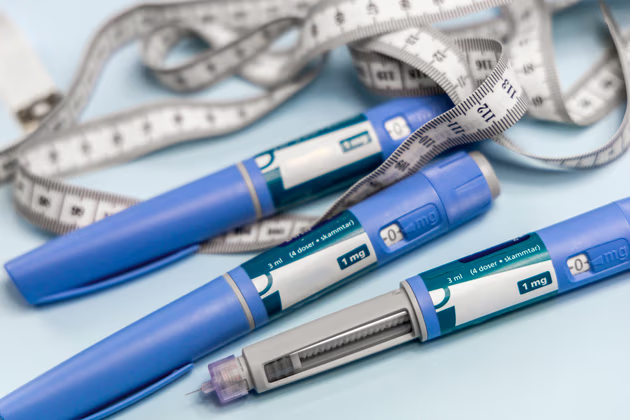
Not long ago, the universal fantasy was to drink coffee without sugar. Today, it has been replaced by a more radical desire: to thin out life itself with a needle.
There was a time when slimming down demanded morning walks and evening salads. Now, GLP-1 class drugs like Ozempic, Mounjaro, and Wegovy have stepped onto the stage.
GLP-1 is a hormone that mimics the body’s own satiety signals. These drugs suppress appetite, slow gastric emptying, and send an earlier “I’m full” message to the brain. The result: smaller portions, faster weight loss, leaner bodies.
On paper, the story is flawless.
The scale drops. The waist shrinks. Blood sugar stabilizes. Cholesterol improves. Before-and-after photos on social media collect applause. People look in the mirror and finally whisper, “At last.”
But here comes medicine’s least favorite word: “But…”
Because losing weight is good, but from where you lose it matters just as much.
Studies on the new generation of metabolic drugs reveal striking results. Eli Lilly, for instance, is testing a drug that delivers an average weight loss of 32 kilograms over 80 weeks. That accounts for more than 28 percent of total body weight, and when extended beyond 100 weeks, losses exceeding 30 percent are being discussed. Do you know what that equals? The outcome of bariatric surgery.
Lilly’s new drug intervenes at three separate points in the body’s hunger and satiety system simultaneously. That means it doesn’t just kill appetite; it targets the stomach, the brain, and the metabolism together to accelerate weight loss.
Truly extraordinary numbers. But this magnitude of weight loss is deeply dangerous. A small detail is being forgotten. These aren’t ordinary users who hear about it on social media and run to the pharmacy. These are carefully selected patients under controlled conditions—medical monitoring, measurement, follow-up, dose adjustment. Laboratory discipline, in other words.
At home, the script runs differently. No appetite in the morning. Two bites at noon. A yogurt for dinner. Then they step on the scale, see the falling number, and declare victory. But the body is quietly drafting a separate report at the same time: protein declining, muscle stimulation dropping, calorie intake falling to alarm levels, vitamin and mineral support insufficient.
The scale says “bravo.” The muscles scream “help.”
This is where the real debate begins. Of those 30 kilograms lost, how much was fat? How much was muscle? How much was water? How much was lean mass? The scale won’t answer these questions.
That is why a new phrase is circulating in the West: a weight-loss epidemic—and weight-loss fragility.
In other words, a person becoming weaker while becoming thinner. Knees trembling on a flight of stairs. Searching for support just to stand up from a chair. Arms tiring quickly while carrying a shopping bag. Unable to summon the old strength even to twist open a jar lid.
What a strange age we live in. A person rejuvenates in their trouser size, yet ages at the bottom of the staircase.
Because with rapid weight loss, lean mass loss accompanies fat loss. Clinical data indicate that in some patients, lean mass loss can approach 10 percent. Lean mass isn’t just muscle; it includes water, connective tissue, and organ tissue. But that doesn’t mean the muscles are spared. Some analyses show that lean mass loss can reach the 15-to-24 percent range of total weight lost, with up to 6 kilograms of lean mass vanishing.
Six kilograms of lost muscle and lean tissue amounts to a decade of bodily aging. It’s that stark.
Muscle is not a beach accessory. Muscle is a metabolic organ. It burns sugar. It utilizes fat. It supports insulin sensitivity. It preserves balance. It loads the bone. It is the invisible insurance policy that prevents falls, fractures, and bed-bound dependency in old age.
If you sacrifice muscle while losing weight, you shrink the engine capacity of your body. Like celebrating a lighter car while you’ve secretly dismantled the engine and stowed it in the trunk.
Moreover, the body is a stingy accountant. It finds unused muscle expensive. When you weighed 100 kilograms, your leg muscles carried that load every single day. That alone is an unconscious form of resistance exercise. When the weight drops rapidly, the mechanical load diminishes. If there’s no weight training, no resistance exercise, no adequate protein intake during that time, the body renders its verdict. It says, “We don’t need this much muscle anymore.”
Then the hips hollow out, the legs thin, the shoulders slump, the arms weaken. The triumph on the scale arrives hand in hand with the thinning of the body’s load-bearing columns.
Another danger is the excessive suppression of appetite. For some injection users, daily intake can drop to 600–800 calories. It looks wonderful from the outside: “I’m never hungry,” “Two bites are enough.” But the body does not applaud this. It registers an alarm.
Because in this pattern, protein becomes insufficient. Amino acids run short. Iron, zinc, B12, vitamin D, calcium, magnesium, and fiber can fall dangerously low. A person can silently hollow themselves out from the inside while losing weight.
And then there is the question of stopping. These drugs are not a “let me lose a few kilos to get beach-ready” tool. Research shows that people who discontinue the injections regain weight up to four times faster than those who lose weight through lifestyle changes. (Source: British Medical Journal)
Some studies report that once the drugs are stopped, up to two-thirds of the lost weight can return within a year. That means a person who loses 15 kilograms faces the risk of regaining close to 10 of them. Worse still, if muscle has diminished, the weight that comes back returns as even more fat.
So the picture can look like this: lose weight rapidly with the drug. Lose muscle. Stop the drug. Appetite comes roaring back. The kilos return. But this time, the person is left with a body that has less muscle, more fat, and a slower metabolism.
That is no longer weight loss. That is the silent deterioration of body composition.
The scale can deceive a person. Muscle cannot. The staircase never, ever can.