
The Unspoken Atrocities: Greek Occupation and the Question of Victimhood in Anatolia (1919–1922)
Abstract
The Greek occupation of Anatolia between 1919 and 1922 remains one of the most contested and emotionally charged episodes in modern Turkish and Greek historiography. While Western narratives often focus on the suffering of Christian minorities in the late Ottoman Empire, the atrocities committed by the Greek army against Muslim Turks during the occupation have been largely overlooked or minimized. This article, based on a comprehensive analysis of the symposium proceedings titled “The Crime Committed by the Greeks Against Humanity in Anatolia: Could the Occupier Be Considered as Victim?”, examines the historical, military, and propagandistic dimensions of the Greek occupation. It argues that the Greek campaign was not only a military invasion but also a systematic effort to ethnically cleanse Anatolia’s Muslim population, and that the occupier cannot be cast as a victim without distorting historical truth.
1. Introduction: The Politics of Memory and Victimhood
The centenary of the Turkish War of Independence has reignited debates over historical justice, memory, and victimhood. In Western historiography, the period of 1919–1922 is often framed within the context of the collapse of the Ottoman Empire, the Armenian Genocide, and the population exchanges that followed the Lausanne Treaty. However, as the symposium organizers provocatively asked: “Could the occupier be considered as a victim?”
This article draws on the contributions of Turkish and international scholars—such as Prof. Edward Erickson, Prof. Jeremy Salt, and Prof. Mustafa Turan—to challenge the dominant Western narrative. It seeks to restore the balance by documenting the war crimes, religiously motivated violence, and destruction carried out by the Greek army and its local allies in Anatolia.
2. The Historical Context: Megali Idea and the Greek Invasions
The Greek occupation of Western Anatolia was not an isolated act but part of a broader expansionist vision known as the Megali Idea (Great Idea), which aimed to restore the Byzantine Empire with Constantinople as its capital. As Prof. Mustafa Turan notes, Greece had already attacked the Ottoman Empire three times between 1897 and 1922, each time with the support of Western powers.
The Treaty of Sèvres (1920) and the secret wartime agreements among the Allies gave Greece a mandate to occupy Izmir and its hinterland. On May 15, 1919, Greek troops landed in Izmir, marking the beginning of a brutal occupation that would eventually cover 12 provinces, including Aydın, Bursa, Eskişehir, and Afyonkarahisar.
3. War Crimes and Atrocities: Evidence from Archives and Memoirs
3.1. Systematic Violence Against Civilians
According to Prof. Bünyamin Kocaoğlu, even before the official occupation, Pontic Greek bands had been terrorizing Muslim villagers in the Samsun region. After the Armistice of Mudros, these activities intensified. The 15th Division of the Ottoman army was redeployed from the Caucasus to suppress these attacks, but the violence continued.
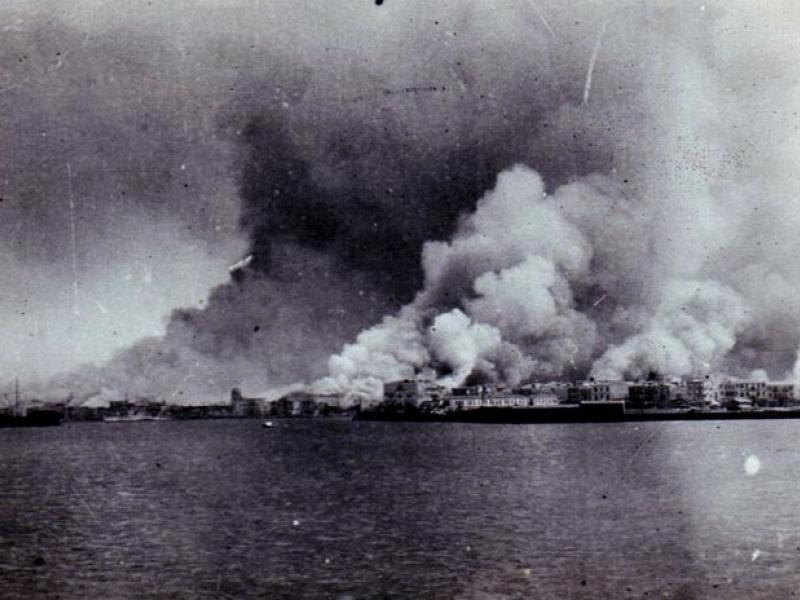
Prof. Esra Özsüer emphasizes that the Greek army committed widespread war crimes, including mass killings, rape, arson, and looting. These actions violated the jus in bello (laws of war) and constituted crimes against humanity. Particularly after their defeat at the Battle of Sakarya (1921) and during their retreat following the Great Offensive (August 1922), Greek forces systematically burned villages and massacred civilians.
3.2. Memoirs and Photographic Evidence
Dr. Nilüfer Erdem’s analysis of Greek soldiers’ memoirs—such as those of Pliziyotis and Vasilikos—reveals shocking firsthand accounts of atrocities. These diaries describe the burning of entire villages, the killing of elderly men, women, and children, and the deliberate destruction of infrastructure. The symposium proceedings also include dozens of photographs from the Turkish Red Crescent and the Turkish Historical Society archives, showing burned buildings, massacred bodies, and refugees fleeing toward Istanbul.
3.3. The Religious Justification of Violence
Prof. Ramazan Erhan Güllü exposes the role of the Greek Orthodox Church in legitimizing the occupation. The Patriarchate of Istanbul, under Venizelos’s influence, portrayed the invasion as a sacred mission to liberate “oppressed Christians.” Muslim resistance was framed as illegitimate, and even violence against Muslims was justified as a religious duty. The Church also collaborated with the Armenian Patriarchate and the Anglican Church to gain international support.
4. Western Complicity and Propaganda
Prof. Jeremy Salt’s paper highlights the role of Western propaganda in shaping public opinion. He argues that deceit, exaggeration, and outright lies were used to justify the Greek invasion. British Prime Minister David Lloyd-George, a close friend of Venizelos, actively supported the occupation despite evidence of atrocities.
Allied investigative reports—some of which are cited in the symposium—acknowledged the scale of Greek atrocities but were ignored for political reasons. As Prof. Teoman Ertuğrul Tulum points out, even Article 59 of the Treaty of Lausanne implicitly acknowledges Greek war crimes, though Turkey waived reparations in a gesture of goodwill.
5. Could the Occupier Be Considered a Victim?
The central question of the symposium is both rhetorical and political. In recent decades, Greek and Pontic diaspora organizations have sought international recognition of a “Greek genocide” allegedly perpetrated by Turks. However, as Dr. Yüksel Küçüker argues, these claims invert historical reality. The real victims were the Muslim Turks, who suffered mass killings, forced displacement, and cultural destruction.
Arnold Toynbee, Mary Edith Durham, and other Western observers of the time testified to the brutality of the Greek army. Toynbee wrote that even Greek commanders were disturbed by the killings in the Yalova-Gemlik region, and the Red Cross documented systematic massacres there.
Thus, the answer to the symposium’s question is clear: The occupier cannot be the victim. To claim otherwise is to rewrite history and perpetuate injustice.
6. Conclusion: Toward a More Balanced Historiography
The Turkish War of Independence was not only a military victory but also a moral struggle against imperialist occupation and ethnic cleansing. The Greek atrocities in Anatolia were not random acts of violence but part of a systematic policy aimed at demographic transformation through terror.
This article calls for a more balanced international historiography—one that acknowledges the suffering of all communities but does not allow the manipulation of history for political ends. The evidence presented in the symposium, including archival documents, photographs, and eyewitness accounts, provides an irrefutable record of Greek crimes against humanity in Anatolia.
As Turkey continues to open its archives and engage in scholarly dialogue, the world must confront the uncomfortable truth: The occupier left behind not only ruins and refugees but also a legacy of silence that must finally be broken.
References (Selected from Symposium Proceedings)
Erickson, E. J. “Modern Memory, Civilian Victimization, and the War in Anatolia.”
Salt, J. “Propaganda and the Greek Invasion of Turkey 1919–1922.”
Turan, M. “Greek Occupations in Anatolia and Genocide Politics.”
Özsüer, E. “War Crimes of the Greek Army in the Turkish National Struggle.”
Erdem, N. “Greek Atrocities in Anatolia in Soldier’s Memoirs.”
Güllü, R. E. “Religious Motivation Behind Greek Occupations.”
Tulum, T. E. “The Silent Truth: Crimes of Greece in Anatolia.”
Küçüker, Y. “Turning Villain into Aggrieved: The Effort of Inventing a Genocide.”
ATASE and Turkish Red Crescent Archives (photographic evidence).
Let me know if you would like a shorter version, a Turkish translation, or a citation-ready academic format (e.g., APA, Chicago).